Partiview
The prime author and current maintainer is Stuart Levy (slevy {at} ncsa.illinois.edu), research programmer at the NCSA. Other contributors to the source code include Steven Marx, from the American Museum of Natural History/Hayden Planetarium (AMNH), who added improvements to the user interface, developed the Mac OS X port, and worked on a fish-eye projection of Partiview. Toshiyuki Takahei of RIKEN wrote a Director plugin and helped Marx port Partiview to OS X. Steve McMillan of Drexel University wrote the "kira" library that partiview uses to draw results of stellar dynamics calculations. Others who have contributed a great deal to design, management, and documentation issues are Donna Cox (NCSA), Peter Teuben (Maryland), and Brian Abbott (Hayden/AMNH). Beginners : the Partiview User Guide by Brian Abbott.
Intermediate : the
Partiview Reference Manual (HTML) (or PDF)
by Peter Teuben and Stuart Levy; or Peter Teuben's
collection of partiview and related reference material.
Other miscellaneous
documentation from Cosmus.
Some past emails from Stuart about commands
for including Maya OBJ files, the warp command to allow the three
spatial coordinates to be arbitrary weighted combinations of as many
dimensions as you specify (and change the weights without having to
restart partiview), compiling partiview with static libraries,...
Also have a look at the archives of the mailing lists for partiview and
the Digital
Universe (once the archives exist, anyway...)
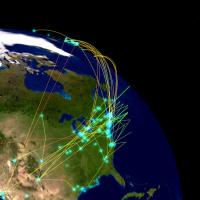
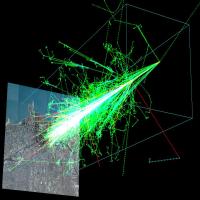
There are many things one can do with a fast 3d+time viewer. Here
are some examples that have free downloads and documentation.
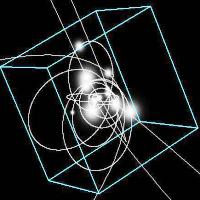
The transneptunian.zip file contains a sample table of orbital elements, partiview .speck files suitable for embedding in the AMNH Digital Universe data, and a stand-alone version of the same, with orbits embedded in the Hipparcos stars. It also provides a tool for adding new orbital elements using text copy-and-pasted from Wikipedia articles on transneptunian bodies.
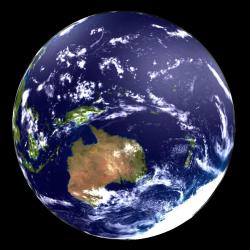
Overlay a rectangular map of a world on a simple sphere and -
voila! - you have a planet.
Documentation:
Documentation:
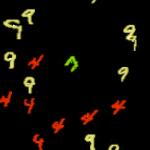
Partiview makes textured 3d scatterplots usable. Three-dimensional
scatterplots are normally clunky to use, but not with partiview. And
having textured glyphs is really cool - sometimes even useful - for
data with a natural visual representation. These, and other features,
turn out to be very useful for testing the output of machine learning
algorithms.
Documentation:
Partiview was used with Virtual Director by groups in Illinois and
New York to meet online in a virtual environment and simultaneously
design the space show "The Search for Life: Are We Alone?" for Hayden Planetarium.
Binaries for partiview for Windows, Linux, and OS X can be downloaded
from the
Digital Universe site.
Windows (Dec 2013) (zipped, 1.5MB).
(older) Mac OS X (10.5), Intel x86, .tar.gz (November 2010) (zipped, 0.4Mb).
Mac OS X (10.7-10.12), Intel x86_64, .tar.gz (Aug 2017) (tar.gz, 1.2Mb).
(older) Linux Intel x86 (November 2010) (zipped, 0.6Mb)
Linux Intel x86-64, RedHat 5 (Dec 2013) (tar.gz, 0.9Mb)
Partiview includes a data-handling and display library that can be
embedded in other systems such as Virtual
Director.
To get the source code, check out the git version - literally -
with the following command:
To compile Partiview you'll also need FLTK 1.1.x or later (current is 1.3.x), from fltk.org.
Here's an example session for compiling partiview on linux, on a
system where you aren't root, and where you have to install FLTK
yourself. We start with assuming that you're in your home directory
/home/elmo
For more details, such as how to compile Partiview on Windows, see the
Reference Guide.
Partiview supports several stereo features, including red-cyan,
chromadepth, and side-by-side.
The side-by-side feature allows Partiview to be used on low-cost
dual-projector polarization-based stereo systems such as the GeoWall. Documentation on that can be
found here.
Partiview does not work on planetarium domes. However, some
major makers of digital domes - such as Sky Skan, Evans & Sutherland -
have written beta-stage plugins that convert files in Partiview format to the
native format of their dome projector software.
Brian Abbott and Ryan Wyatt treated attendees of the 10th Great
Lakes Planetarium Conference to a tour of their Partiview-based
Digital Universe on a Sky Skan dome in October 2004 at the Detroit
Science Museum.
Therefore, if you're an astronomer and want your work to be usable
on a digital dome, publishing it in Partiview format is a good start.
"Interactive 3-D visualization of particle
systems with Partiview" by Stuart Levy, 2001. Appeared in the
Proceedings (Vol 208) of the International Astronomical Union
Symposium on "Astrophysical Supercomputing Using Particles".
Immersive 4D
Interactive Visualization of Large-Scale Simulations by Peter
Teuben, Piet Hut, Stuart Levy, Jun Makino, Steve McMillan, Simon
Portegies Zwart, Mike Shara, Carter Emmart. 2001.
Arxiv preprint astro-ph/0101334. Also in ASP Conf. Ser., Vol. 238,
Astronomical Data Analysis Software and Systems X, ed. F.R. Harnden,
Jr., F.A. Primini, & H.E.Payne (San Francisco: ASP) p 499.
Visualizing
High-dimensional datasets with Partiview by Dinoj Surendran and
Stuart Levy, 2004. Poster Proceedings of Information Visualization 2004.
Visualising
and Analysing Massive Astronomical Datasets with PartiView,
Charles Liu (AMNH). A short powerpoint presentation at a Virtual
Observatory conference in 2002.
More partiview-related references can be found with Google
Scholar.
Partiview is an acceptable entry format for the NSF's Science and Engineering
Visualization Challenge - something that is not at all obvious
from their rulebook. This is because Partiview files can be run off a
CD in Windows without requiring anything to be copied onto the machine
it runs on.
Partiview can be called from Powerpoint by embedding it in an object.
Here are several members of the partiview community mentioned on
this page:
At Hayden
Planetarium at the American Museum of
Natural History:
John
Kielkopf, Department of Physics, University of Louisville
Peter Teuben at the
Astronomy Department at the University of Maryland.
Steve McMillan of
the Physics Department at Drexel University.
Cosmus is an informal
group of individuals from Adler Planetarium & Science
Museum, and the University of Chicago.
Related Software:
Other Partiview sites:
Other projects from NCSA's
Advanced Visualization Lab (AVL) are described here.
Send brickbats for page design to DS. Dec '04
Comments on content? Email Stuart Levy, slevy{AT}ncsa.illinois.edu.
| |||||||||||||||||||||||||||||||||
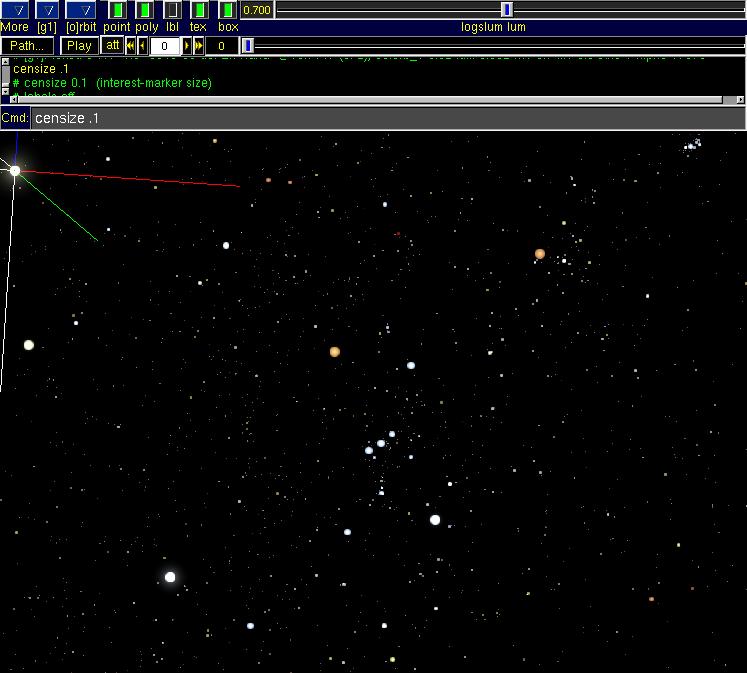
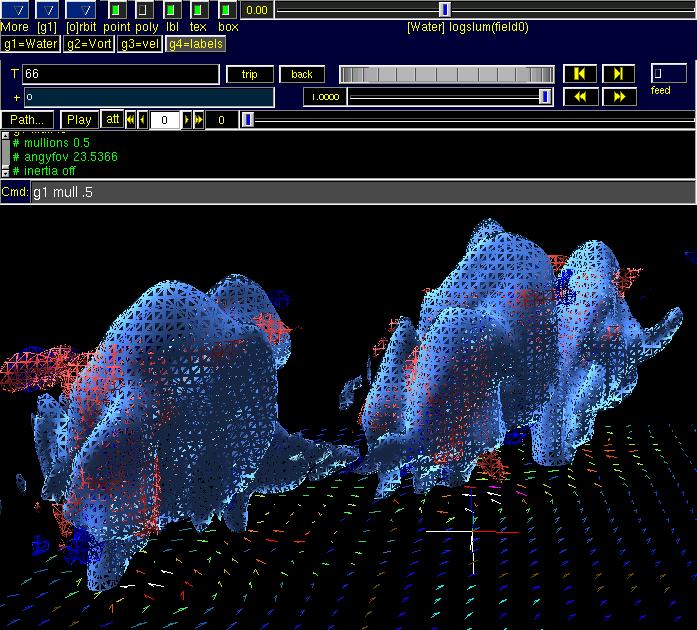 Partiview is free, open-source software from the
  To get Partiview to display your data, the data has to be wrapped
in some ascii (plain text) files. Here's where you can find details of
the wrappers.
To get Partiview to display your data, the data has to be wrapped
in some ascii (plain text) files. Here's where you can find details of
the wrappers.